
Have a seat with...
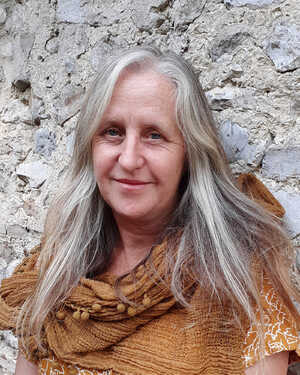
Alice Meacham
Garden Designer
Alice Meacham is a West Country garden designer based on the Devon/Dorset border, working primarily across rural and coastal sites in the region. A Member of the Society of Garden and Landscape Designers, she trained at Kingston Maurward College and holds an RHS qualification from Bicton, and her work has been recognised with an RHS Gold Medal at Tatton Park in 2024 and a Best in Category win at this year's Association of Professional Landscapers Awards.
In today's Have a Seat With, we talk to Alice about the family history in horticulture, designing gardens that hold their own against the elements, and about where she goes when she needs to slow down.
Take a seat, and have a read…
You spent years working in media before retraining and moving back to Devon in 2010. Was there a specific lightbulb moment when you knew garden design was the path forward, or was it more of a slow realisation?
It happened gradually, working on my own garden and then other people’s. I’d spend time with my hands in the soil, then I’d stand back and look around, and realise that often, things weren’t quite in the right place. It all started with me moving things around!
You specialise in rural and coastal sites – sea breezes, woodland edges, wide-open fields – rather than more contained urban plots. Is there anything people misunderstand about designing for that kind of exposure?
Yes absolutely. I explain to them that gardens like Abbotsbury, with its lovely subtropical planting, take advantage of its unique geology and the years of developing shelter to provide screening from the fierce winter winds. While bananas and cannas are beautiful in the summer, for instance, they can look awful after a winter of battering. So I steer clients towards understanding their specific location and the need to select plants that will survive and work not just for one season, but throughout the year.
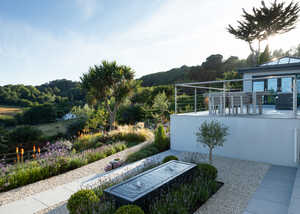
You specify locally relevant timber and stone. How much of that is about a sense of place, and how much is about the quality of local materials and their suitability for coastal and rural sites?
Well, the two go together really – in East Devon, for instance, field flint (or chert) is a readily available local stone, often found in cultivated farmland. It’s hard and dense, and withstands water; it makes sense that this material would have been used historically to build walls and enclosures. So it’s completely at home in a west country informal garden.
Likewise timber – in our wooded valleys here, it’s a readily available construction material, so it feels part of the garden landscape to see rustic benches, features and walling made from wood. Porcelain tiles? Not so much
Your father spent decades as a professional gardener – from the Peabody Trust in 1960s London to Head Gardener across more than fifty estates – before founding his own landscaping practice. You're currently going through the archive of garden plans he drew up over sixty years. What's it been like meeting his work now, as a designer yourself?
It’s fascinating. I realise that I have (consciously or subconsciously) adopted his plant palette! I see a lot of Prunus amanagowa in his plans, and they are a frequent feature in my gardens. I definitely inherited his love of shrubs and foliage; I think we shared the view that flowers are often transitory but shape and form can be permanent.
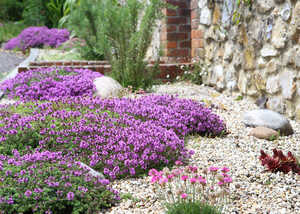
Flowers are often transitory but shape and form can be permanent
Alice Meacham
And do you still use his spade?
Always. It’s a very special tool that’s just the right size for planting 3-litre plants. People often comment on it; I explain it’s one of a kind!
You manage your own garden, where the boundary blurs into the surrounding farmland and wildlife moves freely across it. Is that garden a rest from the working week, or is it something of a testing ground for new design ideas?
It’s a bit like a builder’s kitchen, I’m sorry to say. I can’t look at it without feeling guilty….
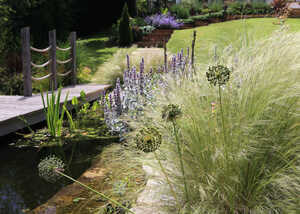
I’m currently experimenting with areas of mown and unmown grass, which I intend to evolve with meadowflower planting. I also have a more formal area which is full of acers in large planters; this is the area that needs the least maintenance and where I go to relax.
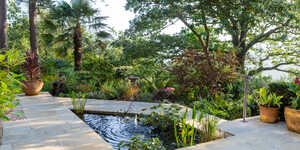
Where do you go – physically or mentally – when you most need to slow down?
To the sea – being able to look across the sea from a cliff top allows your eyes to stretch out. I think the area of cliff between Branscombe and Sidmouth is my all-time favourite.
Is there a garden in Devon and Dorset – excluding your own – that you think everyone should visit once?
Well, I love Coleton Fishacre; for me there’s something about the way the house sits in the valley, and the history of the family that lived there, and has given it a sort of beautiful sadness! Gardens that go down to the sea are very romantic.
What is your favourite season in the garden?
Oh, Autumn! No, wait, Spring. Or maybe Summer….Winter?
Looking ahead, what are you most excited about: a particular project, an idea you are working on, or an event coming up?
I’ve designed a Japanese-inspired boulder garden that I can’t wait to get going on. It involves a lot of Dartmoor slate!
Find out more about Alice's work at www.alicemeacham.co.uk
Have a seat with...
Don’t miss the next conversation
Sign up to our newsletter and we'll let you know when the next interview in the series lands.
Posted by Nickolas Hunter on October 20th 2026
 Updating page...